Description
Mr. Kuo is an adventurer. One day, he finds a maze.
The maze has N rooms. There may be a tunnel between rooms.
There is exactly one simple path between any two different rooms. That is, the maze is a "tree".
Mr. Kuo is curious about the length of the longest path in this maze.
Take the sample test as the example:
- The longest path of the 1st test case is (2 → 1 → 3), whose length is 2.
- The longest path of the 2nd test case is (1 → 2 → 3), whose length is 2.
- The longest path of the 3rd test case is (5 → 7 → 3 → 1 → 4 → 2), whose length is 5.
[Hint]
Instead of performing DFS twice, there is a solution to find the diameter in one DFS. For any tree whose root is \(i\), if we have two properties of its subtrees / children (\(j\)): the longest distance of the (sub-)tree (denoted by \(d\)) and the longest distance to any leaf (denoted by \(p\)). Then we have \(p_i=\displaystyle\max_{\forall j\text{ is a child of }i}(p_j+1)\), and \(d_i\) is either in its subtrees: \(\displaystyle\max_{\forall j\text{ is a child of }i}d_j\) or passing through the root: \(p_i+\displaystyle\max_{\forall j'\text{ is a child of }i}(p_{j'}+1)\), where \(j'\) mustn't be the same as we took in \(p_i\).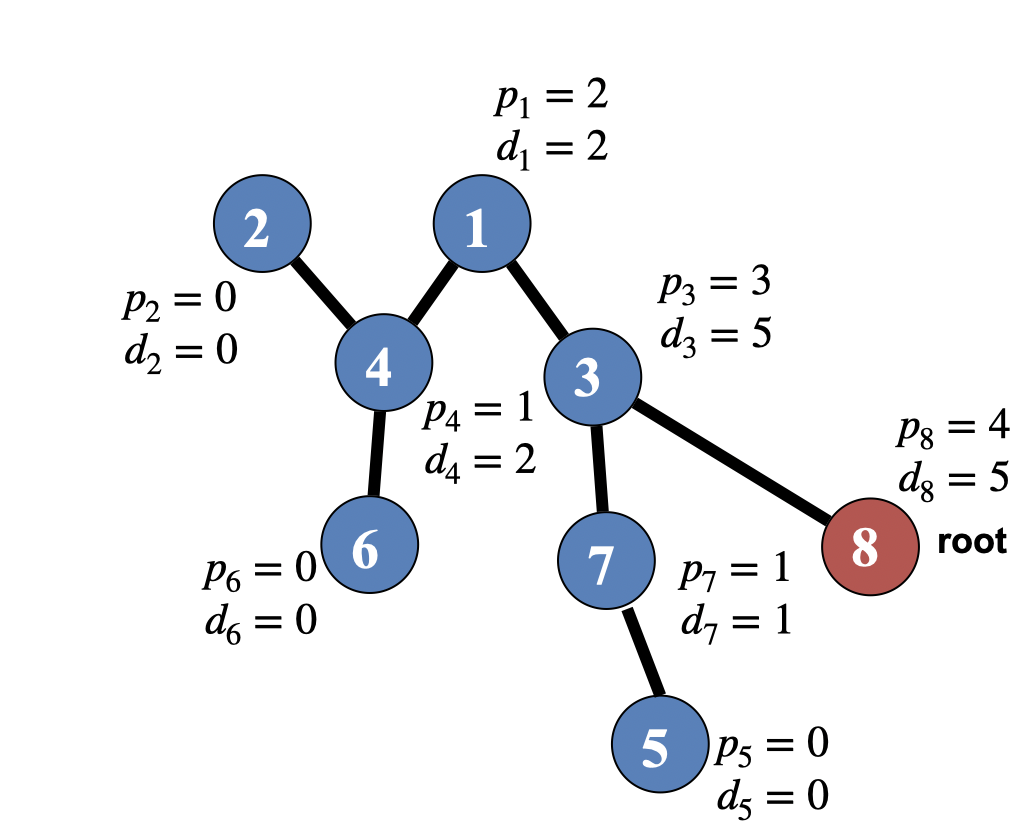
Input
The first line contains one integer T — the number of test cases. Description of the test cases follows.
The first line of each test case contains an integer N — the number of rooms in the maze.
Each of the next N - 1 line contains two integers ui and vi — there is a tunnel between ui and vi.
For each test:
- T ≤ 10, N ≤ 10
- T ≤ 10, N ≤ 100
- T ≤ 10, N ≤ 500
- T ≤ 10, N ≤ 1000
- T ≤ 10, N ≤ 10000
- T ≤ 30, N ≤ 20000
Output
For each test case print an integer — the length of the longest path in the maze.